MEME FIELD NOTES
Ceiling Fan Trend
A spinning fan blade hides each cut while the person below changes outfits from one pass to the next.
Also known as: AI ceiling fan trend · fan transition trend · ceiling outfit transition
TL;DR
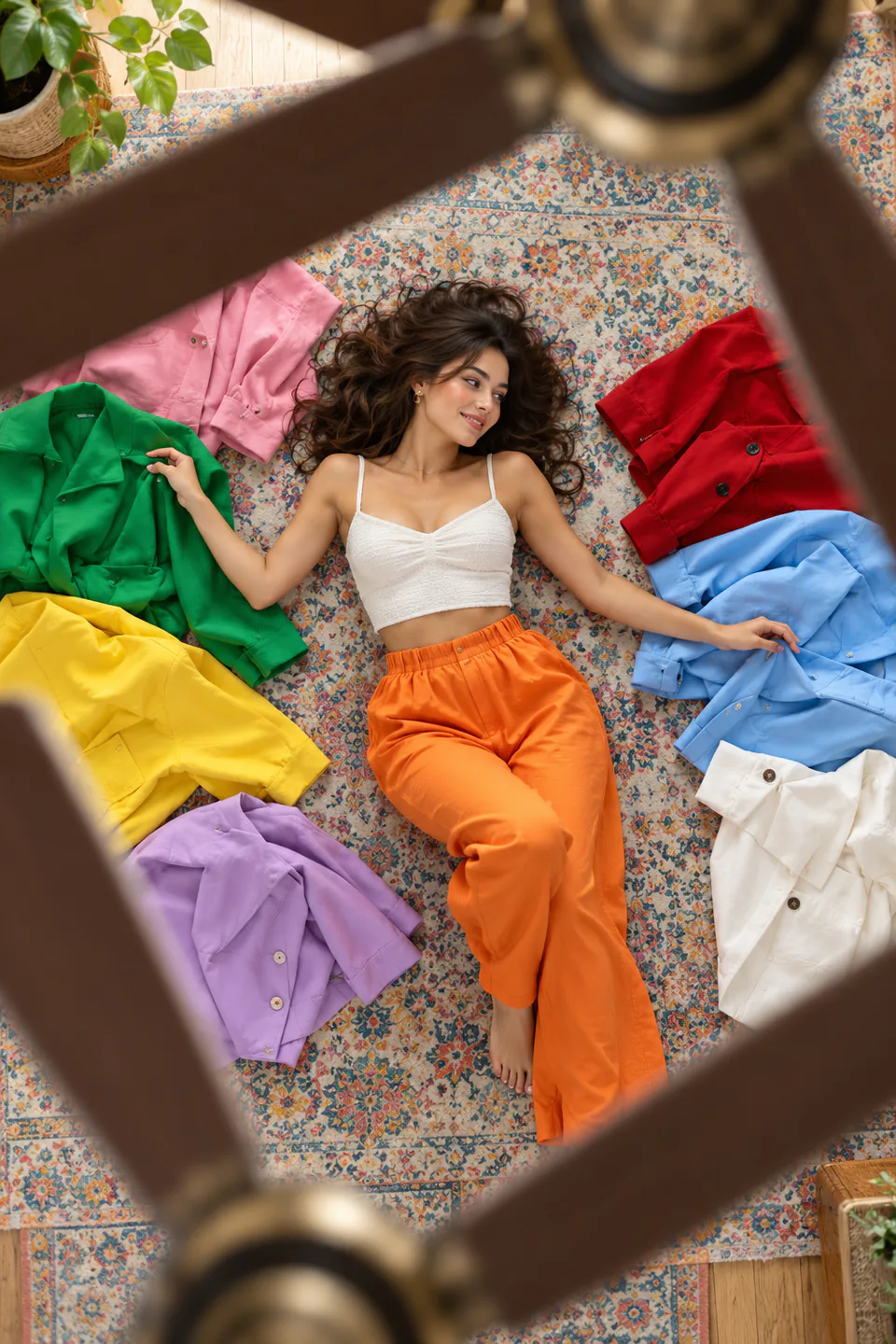
The Ceiling Fan Trend is a top-down outfit-transition video. The camera looks through a spinning fan at a person on the floor or in a bedroom; every time a blade covers the lens, the clothes change. AI templates made the 2026 version possible from one portrait, but the visual trick has roots in the 2023 TikTok ceiling challenge and can still be filmed with practical cuts. Its popularity comes from a transition that explains itself: the moving blade gives every edit a natural place to hide.
What does Ceiling Fan Trend mean?
The Ceiling Fan Trend is primarily a fashion reveal. One person stays in roughly the same pose while several versions of their style pass underneath the fan: casual clothes, streetwear, formal dress and a final party look are common. Captions turn the sequence into a week of outfits, a fantasy wardrobe or “what I would wear if I left the house.”
The fan is more than decoration. A blade briefly fills the camera, creating a wipe transition that the eye accepts as continuous motion. Editors have used objects passing close to a lens for years, but the circular rhythm makes this version feel unusually smooth. Even when the clip is generated, viewers understand where the hidden cut would be.
For clothing accounts, the same setup functions like a compact lookbook. A garment can switch colors on each pass, or the entire room can change from decade to decade. Those brand uses make sense only when the generated clothes are described accurately; an invented AI outfit should not be sold as a product that exists.
Why did Ceiling Fan Trend spread?
The basic shot was already familiar from phone-on-the-ceiling dance and fashion videos. Viewers did not need to learn a new camera language, and creators already knew that a straight-down frame could show a full body in a small room. Adding the fan turned that angle into an automatic transition machine.
AI reduced a difficult shoot to one photo. A practical version needs a securely mounted phone, consistent body position, several outfit changes and careful cuts. Template versions generate the clothes and wipe points at once. Reporting in late September 2026 noted that some results looked realistic enough for viewers to miss the AI origin, which is precisely why disclosure matters.
The trend also invites repetition. Four blade passes mean four reveals, and each new reveal creates another chance for a surprising color or style. Music with an obvious beat gives the sequence a simple editing grid and makes a twelve-second video feel complete.
The overhead angle also changes how viewers read the room. Floors, rugs and furniture become a graphic background, while the person lies inside the frame like part of a flat lay. Practical creators can use that constraint to make an original version with color blocking and real clothes. Generated versions should still check continuity: fan blades must keep the same number and shape, shadows should rotate consistently, and the subject should not slide across the floor between cuts.
Where did Ceiling Fan Trend come from?
The immediate ancestor was the TikTok phone ceiling challenge. Know Your Meme dates an early viral example to October 6, 2023, when a dance filmed from directly overhead used J.I.D’s “Surround Sound.” TikTok’s own trends digest later described the ceiling angle as a recurring format, particularly for fashion and performance.
The fan-transition variation appeared in September 2026. Pixazo listed a “Fan Transition Trend” on September 23, and The Tab reported a wave of AI ceiling-fan videos during the final week of the month. Guides soon offered both a one-photo AI method and a practical method filmed at home.
There is no confirmed single inventor of the effect. It is better understood as a convergence of the older ceiling-camera challenge, object-wipe editing and widely available image-to-video templates.
Ceiling Fan Trend timeline
- Oct 6, 2023An early phone-on-the-ceiling dance helps establish the overhead TikTok challenge.
- Apr 2024TikTok’s trends coverage identifies the ceiling angle as an established visual format.
- Sep 23, 2026A Fan Transition Trend appears in a roundup of new AI video effects.
- Late Sep 2026One-photo ceiling-fan outfit clips spread widely on TikTok.
Popular versions of Ceiling Fan Trend
Four-outfit reveal
The subject moves from everyday clothes to streetwear, formal clothing and a final high-energy look on successive blade passes.
Practical filmed version
A securely mounted phone records several takes, and the editor cuts only while a blade fully covers the lens.
Colorway or decade reel
The subject stays constant while one garment changes color, or the room and styling jump through different eras.
How to join and post Ceiling Fan Trend
- 1If filming for real, secure the phone independently of the fan and keep the fan on a safe low speed; never attach a phone to moving hardware.
- 2Lock the framing, focus and body position across takes, then cut on frames where a blade covers the lens.
- 3Choose a sound with clear beats and align each wardrobe change to the same point in the fan rotation.
- 4Disclose generated outfits and avoid linking an invented item as if it were available to buy.
Sources and further reading
Questions about Ceiling Fan Trend
What is the Ceiling Fan Trend?
It is an overhead outfit video where clothing changes each time a spinning fan blade crosses the camera.
Is the Ceiling Fan Trend made with AI?
Many 2026 versions are generated from one photo, but the effect can also be filmed and edited with practical cuts.
Where did the overhead angle come from?
It builds on the phone-on-the-ceiling TikTok challenge that became popular in 2023.
What song belongs to the trend?
There is no single required track. Creators choose music with a clear beat; some explainers used “Girls on Film.”
Can brands use the Ceiling Fan Trend?
Yes as a lookbook format, provided generated colors or garments are not misrepresented as real inventory.